
In Memory of
Mr. Raymond Johnson
Mr. Raymond Johnson


|

|

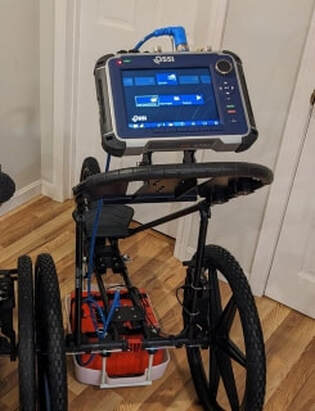
A Ground Penetrating Radar (GPR)
machine. Used in pinpointing the location of graves.
A Mr. Raymond Johnson was the victim of a very
peculiar and heinous homicide in 1955. Such
a machine may be needed to find his grave.
machine. Used in pinpointing the location of graves.
A Mr. Raymond Johnson was the victim of a very
peculiar and heinous homicide in 1955. Such
a machine may be needed to find his grave.
{The total "Memorials" on this Ancestry screenshot are questionable. May 25, 2026, 11:40AM CST}

"Search for cemetery records in Mount Gillion Baptist Church Cemetery, LA
at Find a Grave by entering a surname and clicking search." Search box been sunset. (From 398---401 names)*
at Find a Grave by entering a surname and clicking search." Search box been sunset. (From 398---401 names)*
"Search for cemetery records in Prairieville Community Cemetery, LA
at Find a Grave by entering a surname and clicking search." Search box been sunset. (From 219---220 names)*
at Find a Grave by entering a surname and clicking search." Search box been sunset. (From 219---220 names)*
"Search for cemetery records in Stockton Rural Cemetery, CA
at Find a Grave by entering a surname and clicking search." Search box been sunset. (From 37754---42,683 names)*
at Find a Grave by entering a surname and clicking search." Search box been sunset. (From 37754---42,683 names)*
Case History
Monday, October 1, 2018, 12:00 AM CDT-Monday, May 25, 2026, 12:00 PM CDT
|
SPECIAL NOTE: It appears that as of September 1, 2018, Ancestry.com, now being the new owner of what is now FindaGrave.com, has retired the above search box feature within the new FindaGrave.com website or platform, either temporarily or permanently, wholly, or just partially. Recently, it was requested of Ancestry.com that they engineer a FindaGrave.com search box feature for its new FindaGrave.com platform. When, or if ever, this request is honored this special note will either be removed or edited, accordingly. The search boxes listed above will now direct you, the user, to the respective cemetery listed therein and show all of the registered persons matching the "Surname" that you've keyed in. Thus, just recently, updated numerical search box data (grave count) was discovered via FindaGrave.com and the respective search boxes above were then manually updated accordingly on this particular webpage only. Of special note is the fact that the current owner of FindaGrave has
|
restructured its name to be spelled with a lowercase alphabet "a" in its middle e. g., "FindaGrave" instead of "FindAGrave." This site will leave the search boxes up with the previously structured spelling as new search boxes were never designed by the new owner, Ancestry.com. This is being done not in defiance but mainly as a classical gesture. The latest grave count data within the above search boxes was last manually updated on Monday, May 27. 2024, 11:30 AM CDT. *On this Memorial Day, Monday, May 25, 2026, it is with great sadness that I announce that the sunset time has come for the search boxes formerly owned by FindAGrave. The new owner of what is now FindaGrave.com has elected not to maintain the special designed live search boxes. However, my platform, ClassicShoppes.us will continue annually to manually perform a grave count search and update the grave count data accordingly for at least two of the four cemeteries once listed herein, minus "Hope Haven Garden of Memory in Gonzales, LA."
Lasted updated, Monday, May 25, 2026, 7:00AM-12:00PM CDT |
"Full" and "Half Siblings"
|
"A sibling is one of two or more individuals having one or both parents in common. A full sibling is a first-degree relative. A male sibling is a brother, and a female sibling is a sister. In most societies throughout the world, siblings often grow up together, thereby facilitating the development of strong emotional bonds. The emotional bond between siblings is often complicated and is influenced by factors such as parental treatment, birth order, personality, and personal experiences outside the family. Identical twins share 100% of their DNA. Full siblings are first-degree relatives and, on average, share 50% of their genes out of those that vary among humans, assuming that the parents share none of those genes. Full siblings have the same biological parents and are 50% related (full siblings share 50% of their genes out of those that vary among humans). Birth order is a person's rank by age among his or her siblings. Typically, researchers classify siblings as "eldest," "middle child" and "youngest." Birth order is commonly believed in pop psychology and popular culture to have a profound and lasting effect on psychological development and personality. For example, firstborns are seen as conservative and high achieving, middle children as natural mediators, youngest children as charming and outgoing. Despite its lasting presence in the public domain, studies have failed to consistently produce clear, valid, and compelling findings. "
Source: Wikipedia.org | Saturday, April 20, 2019, 4:10 PM CDT "Full"
|
"Half-siblings are people who share one parent. They may share the same mother but different fathers (in which case they are known as uterine siblings or maternal half-brothers/half-sisters), or they may have the same father but different mothers (in which case, they are known as agnate siblings or paternal half-brothers/half-sisters. In law, the term consanguine is used in place of agnate). They share only one parent instead of two as full siblings do and are on average 25% related. Theoretically, there is a chance that they might not share genes. This is very rare and is due to there being a smaller possibility of inheriting the same chromosomes from the shared parent. However, the same is also theoretically possible for full siblings, albeit (comparatively) much less likely. Because of the formation of Chiasma in late prophase II (cross-over events), both previous statements are generally impossible. In law (and especially inheritance law), half-siblings have often been accorded treatment unequal to that of full siblings. Old English common law at one time incorporated inequalities into the laws of intestate succession, with half-siblings taking only half as much property of their intestate siblings' estates as siblings of full-blood. Unequal treatment of this type has been wholly abolished in England, but still exists in the U. S. [S]tate of Florida."
Source: Wikipedia.org | Sunday, April 21, 2019, 7:00 PM CDT "Half"
|
The Narrative on an Abused/Displaced/Missing Corpse
"The Criminal Matter (State vs. Perpetrator)"
"The state will prosecute the individual who moved the body because the act disrupts a criminal investigation and violates public health and burial laws. The specific criminal charges depend on who displaced the body and why:
"The Civil Matter (Family vs. Perpetrator/Cemetery)"
"While the state handles the criminal penalties (such as prison time), the victim’s family has the right to file a civil lawsuit in civil court to seek financial compensation for damages:
Source: This content was generated with the help of Google’s Gemini AI | Monday, September 14, 2026, 11:38AM CDT
"The state will prosecute the individual who moved the body because the act disrupts a criminal investigation and violates public health and burial laws. The specific criminal charges depend on who displaced the body and why:
- Tampering with Physical Evidence/Homicide Concealment: If the murderer or an accomplice moves the body within the cemetery to hide the crime, delay discovery, or destroy forensic evidence, they face severe felony charges.
- Desecration of Graves or a Corpse: Moving a body out of its designated burial space without legal authorization constitutes grave desecration or grave robbing. In states like Louisiana, for example, the Louisiana Revised Statutes § 14:101 explicitly classifies the unauthorized opening of a place of interment to remove a body as a criminal offense.
- Unlawful Disinterment or Disposal: Moving human remains within a cemetery requires explicit legal permits. Doing so without the proper authorization from the state or a coroner is a criminal violation of public health and cemetery statutes."
"The Civil Matter (Family vs. Perpetrator/Cemetery)"
"While the state handles the criminal penalties (such as prison time), the victim’s family has the right to file a civil lawsuit in civil court to seek financial compensation for damages:
- Intentional Infliction of Emotional Distress (IIED): The family can sue the perpetrator for the severe psychological trauma caused by disrupting their loved one’s final resting place.
- Tortious Interference with a Corpse: This specific civil tort allows next-of-kin to seek damages against anyone who unlawfully disturbs, moves, or mistreats a deceased body.
- Negligence (If the Cemetery is at Fault): If the displacement happened because the cemetery management was reckless, mixed-up plots, or failed to secure the grounds properly, the family can sue the cemetery for breach of contract and negligence."
Source: This content was generated with the help of Google’s Gemini AI | Monday, September 14, 2026, 11:38AM CDT
"Body Farms"

"A body farm is a research facility where decomposition can be studied in a variety of settings. In 1971 a forensic pathologist named Ben Caleb Sturgill thought up the idea along with another pathologist. They were invented by an anthropologist named William Bass in 1972, after he had realized how little was known about decomposition of the human body. Previous to this, in the 1970s, pig remains were used to study decomposition processes. The aim is to gain a better understanding of the decomposition process, permitting the development of techniques for extracting information such as the timing and circumstances of death from human remains. Body farm research is of particular interest in forensic anthropology and related disciplines, and has applications in the fields of law enforcement and forensic science. By placing the bodies outside to face the elements, researchers are able to get a better understanding of the decomposition process. Six such facilities exist in the United States, with the research facility operated by Texas State University at Freeman Ranch being the largest at 26 acres in area."
|
"The six research facilities in the United States can be found at the University of Tennessee in Knoxville, Western Carolina University, Texas State University, Sam Houston State University, Southern Illinois University and Colorado Mesa University. These six research facilities have been deemed "body farms" due to the nature of the decomposition research they perform. Numerous purposes exist for these research facilities, yet the main purpose of these research facilities is to study and form an understanding of the decompositional changes that occur with the human body. This research is then used for medical, legal and educational purposes. Dr. Richard Jantz, a director of the forensic anthropology center, advises others to look where humans look, breathe and smell by watching how humans perform different movements in everyday life. Jantz finds it important to recognize the basic structure and the necessity for the body farms facilities by emphasizing the importance of the environmental events that lead to developing timing of death and understanding of how scavengers interact with decomposition."
This "Body Farms" article continues at "The Unique Galleria 2, 3 & 4," under Find a Grave Source: Wikipedia.org, Monday, May 29, 2017 |
"Deathbed Conversion"

"A deathbed conversion is the adoption of a particular religious faith shortly before dying. Making a conversion on one's deathbed may reflect an immediate change of belief, a desire to formalize longer-term beliefs, or a desire to complete a process of conversion already underway. Claims of the deathbed conversion of famous or influential figures have also been used in history as rhetorical devices. Conversions at the point of death have a long history. The first recorded deathbed conversion appears in the Gospel of Luke where the good thief, crucified beside Jesus, expresses belief in Christ. Jesus accepts his conversion, saying “Today you shall be with Me in Paradise." Perhaps the most momentous conversion in Western history was that of Constantine I, Roman Emperor and later proclaimed a Christian Saint by the Eastern Orthodox Church. While his belief in Christianity occurred long before his death, it was only on his deathbed that he was baptised, in 337. While traditional sources disagree as to why this happened so late, modern historiography concludes that Constantine chose religious tolerance as an instrument to bolster his reign."
Source: Wikipedia.org | Sunday, July 1, 2018, 11:59PM CDT |
"Notable Deathbed Conversions"
"Charles II of England reigned in a Protestant nation at a time of strong religious conflict. Though his sympathies were at least somewhat with the Catholic faith, he ruled as an Anglican, though he repeatedly attempted to lessen the persecution and legal penalties affecting non-Anglicans in England. As he lay dying following a stroke, released of the political need, he was received into the Catholic Church."
Source: Wikipedia.org | Monday, July 2, 2018, 3:50PM CDT 
"The most famous French fabulist published a revised edition of his greatest work, Contes, in 1692, the same year that he began to suffer a severe illness. Under such circumstances, Jean de La Fontaine turned to religion. A young priest, M. Poucet, tried to persuade him about the impropriety of the Contes, and it is said that the destruction of a new play of some merit was demanded and submitted to as a proof of repentance. La Fontaine received the Viaticum, and the following years, he continued to write poems and fables. He died in 1695."
Source: Wikipedia.org | Monday, July 2, 2018, 3:50PM CDT |

"Sir Allan Napier MacNab, Canadian political leader, died 8 August 1862 in Hamilton, Ontario. His deathbed conversion to Catholicism caused a furor in the press in the following days. The Toronto Globe and the Hamilton Spectator expressed strong doubts about the conversion, and the Anglican rector of Christ Church in Hamilton declared that MacNab died a Protestant. MacNab's Catholic baptism is recorded at St. Mary's Cathedral in Hamilton, performed by John, Bishop of Hamilton, on 7 August 1862. Lending credibility to this conversion, MacNab's second wife, who predeceased him, was Catholic, and their two daughters were raised as Catholics."
Source: Wikipedia.org | Monday, July 2, 2018, 3:50PM CDT "Spurious Deathbed Conversion"
"One famous example is Charles Darwin's deathbed conversion in which it was claimed by Lady Hope that Darwin said, "How I wish I had not expressed my theory of evolution as I have done." He went on to say that he would like her to gather a congregation since he "would like to speak to them of Christ Jesus and His salvation, being in a state where he was eagerly savoring the heavenly anticipation of bliss." Lady Hope's story was printed in the Boston Watchman Examiner. The story spread, and the claims were re-published as late as October 1955 in the Reformation Review and in the Monthly Record of the Free Church of Scotland in February 1957. Lady Hope's story is not supported by Darwin's children. Darwin's son Francis Darwin accused her of lying, saying that "Lady Hope's account of my father's views on religion is quite untrue. I have publicly accused her of falsehood, but have not seen any reply." Darwin's daughter Henrietta Litchfield also called the story a fabrication, saying "I was present at his deathbed. Lady Hope was not present during his last illness, or any illness. I believe he never even saw her, but in any case she had no influence over him in any department of thought or belief. He never recanted any of his scientific views, either then or earlier. We think the story of his conversion was fabricated in the U. S. A. The whole story has no foundation whatever."
Source: Wikipedia.org | Monday, July 2, 2018, 3:50PM CDT |

"Author and wit Oscar Wilde converted to Catholicism during his final illness. Robert Ross gave a clear and unambiguous account: ‘When I went for the priest to come to his death-bed he was quite conscious and raised his hand in response to questions and satisfied the priest, Father Cuthbert Dunne of the Passionists. It was the morning before he died and for about three hours he understood what was going on and knew I had come from the South in response to a telegram that he was given the last sacrament. The Passionist house in Avenue Hoche, has a house journal which contains a record, written by Dunne, of his having received Wilde into full communion with the Church. While Wilde's conversion may have come as a surprise, he had long maintained an interest in the Catholic Church, having met with Pope Pius IX in 1877 and describing the Roman Catholic Church as "for saints and sinners alone–for respectable people, the Anglican Church will do." However, how much of a believer in all the tenets of Catholicism Wilde ever was, is arguable, in particular, against Ross's insistence on the truth of Catholicism. "No, Robbie, it isn't true." "My position is curious," Wilde epigrammatized, "I am not a Catholic, I am simply a violent Papist."
Source: Wikipedia.org | Monday, July 2, 2018, 3:50PM CDT |

ClassicShoppes.us
~Where Class & Distinction Meets~
~Where Class & Distinction Meets~
